Does Boiling Water Kill Mold? Heat Treatment for Mold Removal
Mold is one of the most persistent household problems, showing up in kitchens, bathrooms, basements, and even inside appliances. Beyond looking unpleasant, certain molds can cause allergic reactions, asthma flare-ups, and other health concerns. While there are many mold removal products on the market, some contain harsh chemicals and can be expensive. This leaves many homeowners wondering: Can you simply use boiling water to kill mold?
Key Takeaways
- Boiling water reaches temperatures that can kill most mold spores on contact.
- Mold typically dies between 140°F and 160°F, but higher heat can be more effective.
- Heat works best for small, heat-safe items and should be applied carefully to avoid damage.
- Using boiling water has limitations; it’s not practical for large or porous surfaces.
- Long-term mold prevention depends on controlling moisture and improving ventilation.
Understanding Mold Growth in the Home
Mold is a type of fungus that thrives in damp, poorly ventilated environments and spreads through microscopic spores. Indoors, it often appears as fuzzy black, green, and white patches or thread-like structures. Mold requires specific conditions to encourage its growth, including:
- Moisture – from leaks, condensation, or high humidity
- Organic material – like wood, paper, fabric, or dust
- Warmth – indoor temperatures often provide ideal conditions
Common Household Mold Strains You Might Encounter
| Mold Type | Appearance | Common Locations | Health Concerns |
|---|---|---|---|
| Black mold (Stachybotrys chartarum) | Dark black/green patches | Drywall, wood, carpet after water damage | Respiratory issues, mycotoxin exposure |
| Aspergillus | Green, yellow, or white | HVAC systems, ventilation ducts | Allergies, lung infections in at-risk groups |
| Penicillium | Blue or green fuzz | Fabrics, insulation, wallpaper | Sinus irritation, respiratory discomfort |
| Cladosporium | Olive-green to black | Wood, carpets, HVAC systems | Allergy-like symptoms, asthma flare-ups |
By understanding the common household mold strains, property owners can identify the early signs and take preventive measures. If the mold infestation is large, consider contacting mold remediation professionals to thoroughly remove mold from your property.
At What Temperature Does Mold Die?
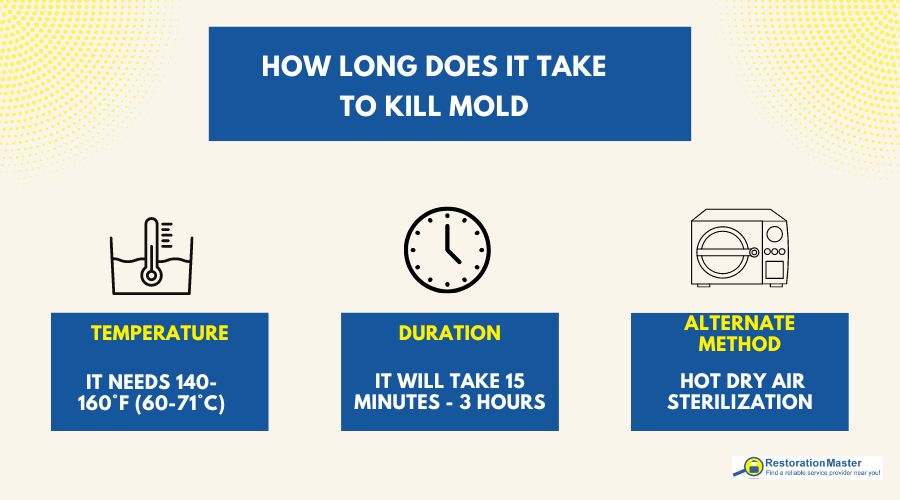
Research from the U.S. Department of Agriculture (USDA) shows that most mold strains die when exposed to sustained temperatures between 140°F and 160°F (60°C to 71°C). However, killing mold spores completely may require even higher heat or longer exposure times.
For example:
- Boiling water (212°F / 100°C) can kill mold and spores on contact.
- Hot dry air sterilization (around 140°F for 3 hours) is another proven method, but it requires specialized equipment used by mold remediation professionals.
Important: Just because heat kills mold doesn’t mean the surface is safe; dead mold can still cause allergic reactions if not removed. Heating your home to excessively high temperatures for extended periods can make the mold worse. This is because air retains more moisture at higher temperatures, leading to increased humidity and, consequently, more mold growth. While heat does have the ability to kill mold, it may not be the most effective method for eradicating it from your home or business. In such instances, seeking professional assistance to tackle the issue might be a better approach.
Does Boiling Water Kill Mold?
Yes, boiling water can kill mold by exposing it to temperatures far above the range most mold species can survive. At 212°F (100°C), boiling water destroys the cellular structure of the mold and renders its spores nonviable. This makes it an effective method for disinfecting small, non-porous items such as glass jars, metal tools, ceramic dishes, or certain cookware.
However, boiling water is not practical for large surfaces or porous materials like carpets, drywall, upholstered furniture, or wood. In those cases, mold can penetrate deep into fibers and crevices where boiling water cannot reach. Even if the surface mold appears to be gone, hidden colonies may remain alive inside the material and regrow once conditions are right.
Boiling water is best suited for items that can be fully submerged without damage, and it should be combined with thorough scrubbing and complete drying to prevent the return of mold. For structural materials or larger infestations, professional remediation is the safer, more effective choice.
How to Kill Mold Spores with Boiling Water
- Scrub First: Wash the item with soap and water to remove visible mold.
- Boil Water: Bring clean water to a rolling boil in a large pot.
- Submerge Item: Place the moldy item in boiling water for at least 15 minutes.
- Air Dry Completely: Dry the item in a clean, well-ventilated area.
Only use this method on heat-safe materials (stainless steel, heat-safe glass, non-porous ceramic items, and some hard plastic items). Avoid boiling anything made of wood, fabric, or delicate plastics, as the heat can cause warping, shrinking, or melting.
Using Boiling Water to Remove Mold | RestorationMaster Video
Risks and Limitations of Using Heat to Kill Mold
While boiling water is an effective spot treatment, it’s not a universal mold solution. Risks include:
- Damage to materials (melting, cracking, discoloration)
- Incomplete removal if spores are inside porous surfaces
- Humidity increases if the steam is not ventilated properly
- Survival of heat-resistant spores under certain conditions
It is important to insulate or ventilate the area affected by mold so that you do not burn out the source material that you are treating. Also, heating an entire room to high temperatures is not recommended without professional mold specialist guidance. High indoor heat can increase humidity, which may actually encourage more mold growth.
Alternative Mold-Killing Methods
Property owners should note that boiling water should only be used to kill mold on items that cannot be harmed by moisture or extreme heat; otherwise, you may end up with more damage than you started with. If boiling water isn’t practical for your situation, consider these alternatives:
- Vinegar: Naturally acidic and safe for many surfaces
- Hydrogen peroxide: Effective against mold spores and bacteria
- Baking soda: Gentle abrasive for scrubbing mold from surfaces
- Commercial mold removers: Stronger for severe infestations
- Steam cleaning: Uses pressurized steam for certain fabrics and tiles
How to Prevent Mold in Your Home
Mold poses a significant challenge in both homes and businesses, negatively impacting the environment within. Killing mold is only half the battle; preventing it from returning is key. Fortunately, proactive steps can be taken to mitigate the risk of mold growth. Here’s how:
- Keep indoor humidity below 50% with dehumidifiers or air conditioners
- Fix plumbing leaks promptly
- Use exhaust fans in bathrooms and kitchens
- Clean and dry wet surfaces within 24–48 hours
- Store items in dry, ventilated spaces
When to Call a Mold Remediation Professional
Boiling water is a quick, chemical-free way to kill mold on small, heat-safe objects, but it’s not a whole-house solution. For larger problems, professional remediation is the safest and most effective choice.
If mold covers an area larger than 10 square feet, is inside HVAC ducts, or involves toxic black mold, call a professional. Certified mold remediation technicians use advanced heat treatments, HEPA filtration, and containment procedures to safely remove mold without spreading spores.
FAQs – Using Boiling Water to Kill Mold
Does boiling water kill black mold?
Yes. Boiling water can kill black mold on small, non-porous items if they can safely handle high heat. The key is to scrub the surface first and fully submerge the item in boiling water.
How long does boiling water take to kill mold?
Boiling water kills most mold instantly upon contact. For the best results, keep the item in boiling water for at least 15 minutes.
Does boiling water kill mold in the sink?
Yes. Pouring boiling water down the sink can kill mold on the drain surface, but it will not remove deeper growth in pipes. Scrubbing and cleaning are still needed.
Can heat kill mold spores on household objects?
Yes. Most mold spores die at temperatures above 140°F. Boiling water and steam cleaning are effective for heat-safe materials like glass, metal, and some plastics.
Does heat kill mold on food?
Heat can kill mold on food, but it does not make the food safe to eat. Mold can produce toxins that remain even after heating, so moldy food should be thrown away.

About Vince Sandri
Vince Sandri is a disaster restoration content specialist with more than 12 years of experience researching, writing, and educating property owners about water damage, fire and smoke damage, mold remediation, storm damage, and other disaster recovery topics. Since 2014, he has served as the lead contributor to RestorationMaster.us, where he has developed hundreds of in-depth service pages, educational guides, and industry-focused articles for restoration professionals across the United States.
Through extensive research and ongoing collaboration with restoration contractors, Vince has built a strong foundation in the science, processes, and best practices behind property damage mitigation and recovery. His work aligns with industry standards like the IICRC and EPA guidelines, and helps homeowners, business owners, and property managers understand how disasters impact structures, what immediate steps to take, how professional restoration works, and how to prevent long-term structural and health risks.
Vince specializes in translating complex restoration procedures — including water extraction, structural drying, smoke odor removal, mold containment, and storm damage repair — into clear, actionable information that empowers readers to make informed decisions during high-stress situations. His content aligns with industry standards and focuses on safety, accuracy, and practical response strategies.
He earned his Bachelor of Arts degree from Aurora University and his master’s degree from DePaul University. Since 2012, Vince has focused on SEO-driven website content, technical service pages, and educational resources within the disaster restoration industry.
Outside of his professional work, Vince is also a musician and performs in the Chicago, IL area.